AddThis Social Bookmark Button
FaceBook RadonSeal page
sealer sale

Backup Sump Pumps Made Reliable

Do you need a backup sump pump?

Most homeowner insurance policies do not cover damage from ground water flooding. You may have invested over $20,000 in basement remodeling or all your important “stuff” is stored in the basement.

  • Do you worry about your sump pump during a heavy rain?
  • How about the next hurricane? Or a big snow melt?
  • While on a vacation, do you think about your sump pump?
  • When leaving on a business trip, do you worry more about your sump pump than your family?

If any of your answers is YES - you need a back-up sump pump! Our back-up pumps are fully automatic and will take over whenever the primary pump fails or cannot keep up for any reason.

Homeowners insurance usually does not cover basement flooding caused by ground water. If your basement depends on a sump pump, you need a backup sump pump! For a small one-time investment, you get basement flood protection and peace of mind. The average cost of a midrange basement remodeling project was $61,011 in 2008-2009 (Remodeling Magazine). The back-up sump pump is an inexpensive flood insurance.

Why sump pumps fail

  • Float switch broken or stuck
  • Too much water overwhelming the pump
  • Clogged sump pump intake screen
  • Sump pump humming but not pumping (air-locked)
  • Sump pump jammed by mud or a stone
  • Power failure (usually happens during heavy storms)
  • Tripped circuit breaker or a blown fuse
  • Sump pump burned out
  • Broken pump impeller or drive shaft
  • Clogged or frozen sump pump discharge

Our back-up sump pump solutions

We supply two alternative sump pump back-up systems which provide the highest reliability and pumping capacity in the industry, as well as an easy do-it-yourself installation:

  • Battery backup sump pump
  • Water-powered backup sump pump

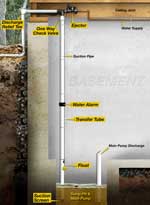
What, in the world, is a water-powered pump? Like fighting fire with a fire, you can pump water with water. It works on a well-proven high school concept. When municipal water blasts at full pressure through a Venturi nozzle ("ejector"), the pressure drop inside the nozzle draws in water from the sump like through a giant soda straw. It does not depend on electricity or batteries, and there are no moving parts. Provided the municipal water is on, it can run infinitely during a power outage.

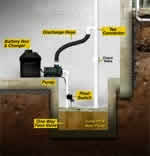
Unlike most back-up sump pumps, our residential pumps are located out off the sump water to avoid grime, corrosion, and debris. Water softeners dumping brine and salt water into sump pits accelerate corrosion further and cause premature sump pump failure. Our residential battery back-up sump pump is located high and dry next to the sump pit. And our water-powered pumps are located even higher on the ceiling above the sump. This makes our backup pumps very unique and provides maximum reliability and longevity.

Our pumps do not interfere with the primary sump pump and its float inside the sump pit. Their capacity is several time larger than the store-sold pumps.

The suction pipe reaches to the bottom of the sump pit, so that the pump can empty the whole pit, including the drain tiles. Other pumps sit above the main pump and empty the pit only partially. They suffer from overheating due to frequent start-ups and leave water inside the footing drains.

Your choice of backup sump pumps


Water-powered backup sump pumps
Battery backup sump pumps
Operation

3 models for 750, 1,000, and 1,500 GPH at a 10-ft. lift. Installed high and dry.
Runs infinitely during a power outage.
No moving parts. No maintenance. No battery cost.
5-Year Limited Warranty!

3 models for 900. 1,400 and 1,800 GPH at a 9-ft. lift.
Runs up to 4 or 8 days depending on the pumping cycles.
Installed outside the sump pit.

Installation Basics
Requires basic plumbing to connect municipal water supply.
The easiest installation – place and connect to the discharge piping.
water-powered backup sump pump
battery backup sump pump
1. Mount on a joist above the sump. 1. Place next to the sump.
2. Connect with plastic or copper piping to your water supply (plumbing kits available). 2. Get a battery (charger is included). Plug in.
Connect to discharge pipe. All installation parts included.
3. Install PVC suction pipe. 3. Install suction pipe (included).
4. Install discharge pipe to the outside (included) or connect to the primary discharge pipe. 4. Connect to the primary discharge pipe (connector included).
Operating Costs
Using water for pumping is somewhat more expensive that electricity.
Click for Detailed Information:
Water-powered backup sump pumps Battery backup sump pumps

Back-up sump pumps sold in stores

Cheap but unreliable. Short life. Like having a spare tire that may be flat. Installed inside the sump pit, interfering the the primary pump and its float. Limited pumping capacity, pushing all discharge water up against gravity.

Any alternatives to backup sump pumps?

Electric generators
Most have no automatic switch and somebody has to be around to turn the generator on. Due to toxic emissions, they have to be located outside but when exposed to rain and snow, they do not last long. Some have cheated by placing them in a garage but with tragic consequences.

You would have to buy the very expensive automatic model ($1,000s) to start your sump pump running when you are away. The generator capacity is limited, usually designed to run just the fridge, a TV and a few lights. You would have to hire a plumber to connect natural gas and an electrician to re-wire the panel. But, worst of all, it is only a partial solution – it will not help at all in about 50% of cases when the problem is the pump itself or simply, a stuck float.

Battery back-up units convert the direct current from a battery into AC for the existing sump pump. Quite expensive and this solution also remains dependent on the same old sump pump and float working.

Is your sump pit too small?

The standard sump pit insert available in home improvement centers is 26 gallons and 18" diameter. But many sump pits just use a common 5-gallon bucket. Such a small pit fills up with water very quickly and the sump pump has to turn on and off frequently, which shortens the life of the pump, as well as its check valve. But installing a backup pump into such a small pit is impractical because of the risk of its float getting stuck and the basement flooding.

Our residential backup pumps are not placed inside the sump pit. They only need enough space for the suction pipe and a float. And our battery sump pump features a slim-line vertical switch, taking much less space than a regular float switch.

In case the sump pit is still too small or crowded, you may need to dig through the bottom of the pail to place the main pump deeper, or to cut the concrete to install a full-size sump pit.

What pump capacity do I need?

If you are an engineering type, you can estimate the needed approximate capacity of the back-up sump pump. As an indication of the minimal pump capacity needed, calculate the volume of water based on the volume of the sump insert. On a rainy day, insert a yard stick into the sump to the low water level. Then, read how many inches the water rises in one minute.  

Sump water flow (GPH)
water rise in one minute
    2" 4" 6" 8" 10" 12"
sump
diameter
16" 120 240 300 420 540 660
18" 120 300 420 540 660 780
20" 180 360 480 660 840 960
22" 180 420 600 780 1,020 1,200
24" 180 480 720 960 1,200 1,380

Example: An 18" sump with a water rise of 6" per minute represents a flow of 420 US gallons per hour.

However, because the sump insert allows ground water to gush in from footing drains and the surrounding gravel bed, the pump has to remove much more water in each cycle than just the volume of the sump insert. During a really heavy storm, the water inflow will be higher. Therefore, add at least 50 percent to estimate the needed capacity of the backup sump pump.

Then, you have to measure the needed lift – how high has the pump deliver the water from the bottom of the sump pit. A pump can remove much more water at a 5-ft "head pressure" than if has to pump 10 ft. high. Add an extra foot for each elbow.

concrete sealers

MADE IN USA
Products not sold through retail stores. Available exclusively from:
Radon Mitigation & Concrete Waterproofing Co., Novion Inc.,
18 L'Hermitage Drive, Shelton, CT 06484 USA
RadonSeal™ is a registered trademark. Copyright © 1998-2010. All rights reserved.

BioZap mold cleaner sale

Quick Answers


E-Mail us
BBBOnLine Reliability Seal
Payment Processing