
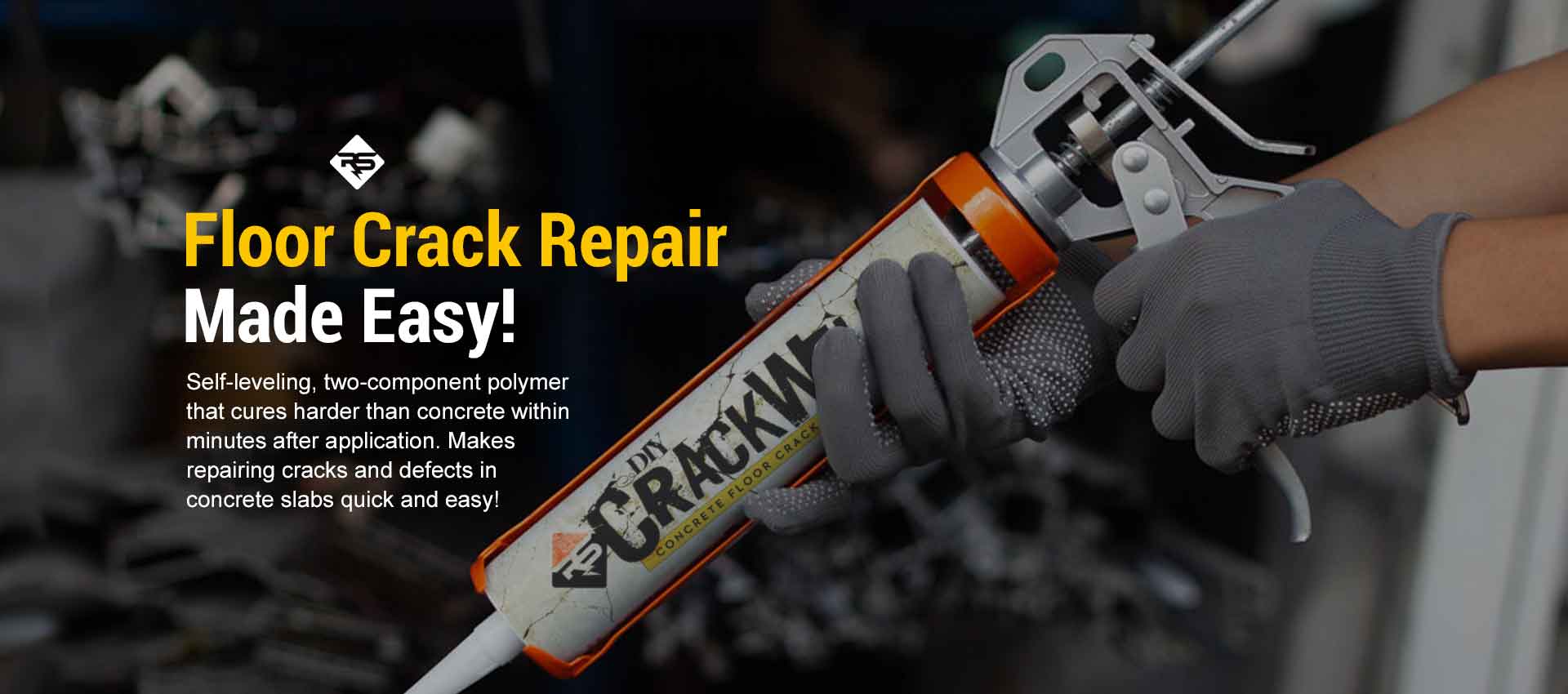
Make Concrete Floor Crack Repair Easy on Yourself
CrackWeld Concrete Floor Crack Repair Kits make repairing cracks in slabs easy-breezy! Unlike other repair materials, this low-viscosity polymer gravity feeds into thin stress cracks, hairline cracks, holes, defects, and fissures in concrete floors without the need to route or chase the crack.
CrackWeld cures in minutes as a rigid compound that becomes stronger than the concrete itself. CrackWeld “welds” cracks in concrete slabs together, providing building contractors, floor installers, and DIY homeowners with an easy and lasting repair of indoor and outdoor slab cracks.
Why Repairing Cracks in Foundation Slabs Should Never Be Ignored
Cracks are the most common problem for indoor or outdoor concrete slabs, basement floors, driveways, garage floors, patios, pool decks, sidewalks, and parking areas. When a crack is not properly, and quickly repaired, the situation becomes more problematic. Cracks left unattended cause further cracking, spalling, and disintegration of the concrete.
- Rainwater – Water gets to the reinforcing steel, making it rust and expand, causing more cracking and concrete pop-outs.
- Freeze-Thaw – Freeze-thaw cycle of trapped water widens concrete cracks.
- Water Seepage – The seepage of water, water vapor, and radon gas through cracks into homes and buildings.
- Trapped Moisture – Moisture destroys flooring materials and may cause mold infestation.
- Efflorescence – Water leaches out of the concrete and causes efflorescence.
- Surface Traffic – Vehicular traffic crumbles the edges of cracks.
- Expansion/Contraction – The cracks will get wider and longer due to the natural movement of concrete.
- Flooring, Epoxy, & Overlays – Cracks propagate into rigid flooring tiles or concrete overlays.
- Radon & Soil Gases – Radon and soil gases easily flow through cracks. Contributing to elevated indoor radon levels.
Increase Concrete Density with RadonSeal Penetrating Concrete Sealer
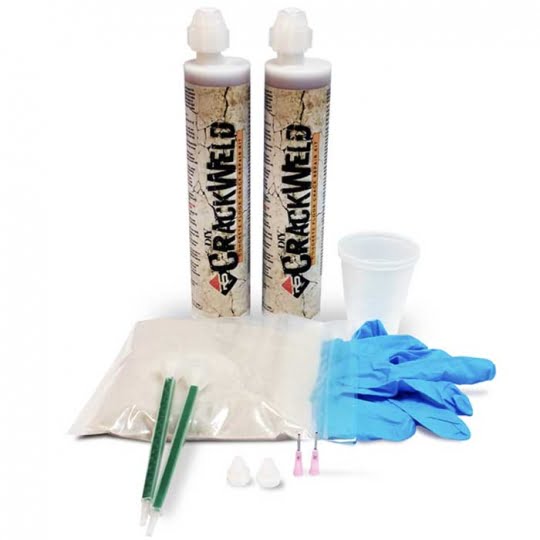
CrackWeld Floor Repair Kit 2-Pack
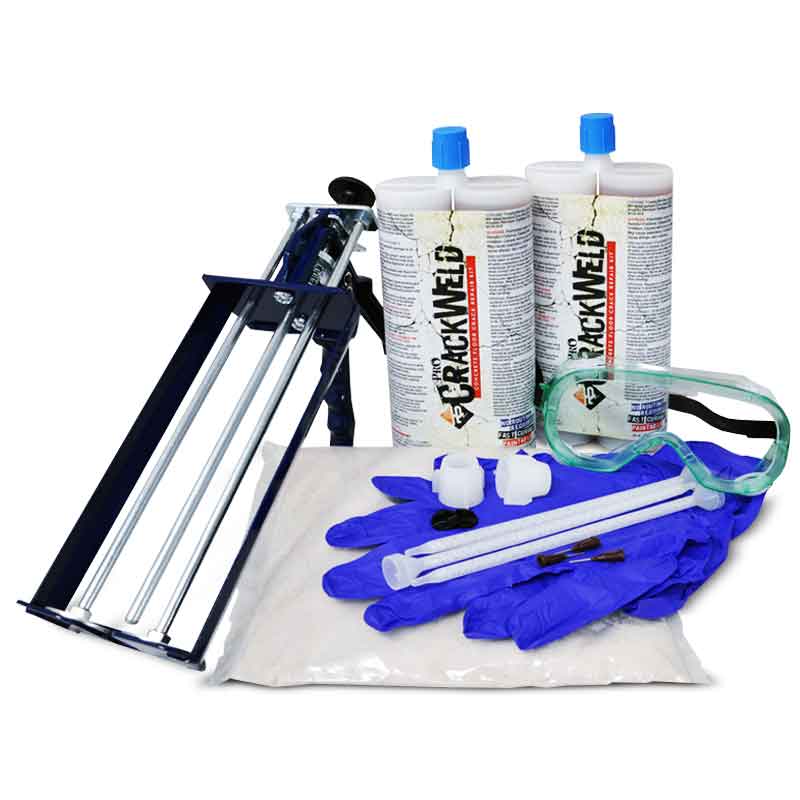
CrackWeld PRO Floor Repair Kit
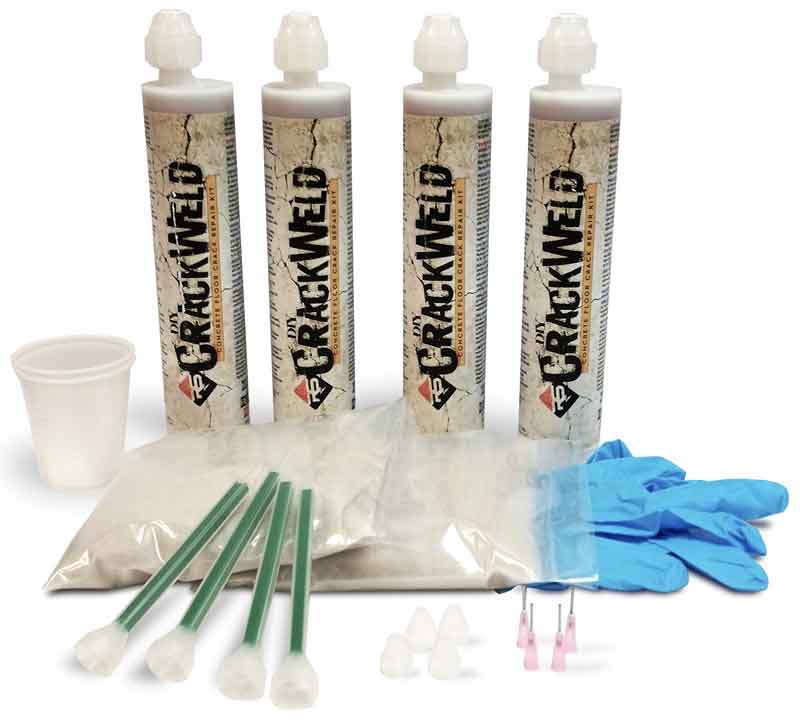
CrackWeld Floor Repair Kit 4-Pack
CrackWeld Advantages – Repairing a Crack in Concrete Slabs
CrackWeld is a two-component compound similar to epoxy injection, but only 1/10 as vicious, thus eliminating the need to chase, widen, route, or chisel out the crack before use. The compound bonds with sand to form an indestructible, impermeable mass inside cracks, spalls, or holes. It plugs cracks and holes, sealing voids against water seepage, water vapor, insects, radon, and soil gases.
CrackWeld cures strong (5,000 psi), and offers a structural repair for indoor and outdoor concrete floor cracks. It bonds and helps prevent cracks from further movement, due to expansion and contraction. Use CrackWeld for residential and commercial applications such as; high vehicular and foot traffic areas, and slab-on-grade construction. Use on hairline and wide cracks.
Note – CrackWeld is not suitable for joints that require a flexible material, such as; expansion control joints (saw cuts), floor-to-wall joints in basements, and saw cuts. For sealing cold joints (cove joint), expansion joints, and floor-to-wall joints, use ElastiPoxy Joint & Gap Filler Kit.
- No Routing Required –Eliminates the need for a cold chisel or grinding disk.
- Fills Hairline Cracks – Low viscosity. Self-levels. Gravity feeds The kit includes needle nozzles for hairline crack repairs.
- Cures Fast – Cures concrete hard in 15-30 minutes before installing overlays, flooring, paint, epoxy, and heavy vehicular traffic.
- Cures Stronger than Concrete – Bonds concrete to prevent elongation and yawning of cracks. Cures at 5,000 psi.
- Freezing Temps – Can be applied in sub-freezing temperatures.
The Wrong Way to Repair Cracks in Concrete Floors
Self-Leveling Polyurethane Caulk – Covering the crack with caulk is cheap and easy, but the repair is only short-term. Water wicking through the concrete or trapped water vapor will weaken its bond to the concrete, which may show up as efflorescence. The caulk will not last under heavy traffic. After a couple of years, the caulk loosens and peels away.
Hydraulic Cement – Hydraulic cement is a temporary fix. Yes, it has waterproofing qualities, but it does not bond well to concrete, which is the reason why you have to chisel out the crack as an inverted V-groove to hold it in place. It also is more rigid than concrete, however, concrete continually moves, shrinks, and expands, loosening the stiff hydraulic cement patch. After a few years, water seepage and efflorescence will appear around the edges of the plug.
CrackWeld PRO Floor Crack Repair Kits
The Complete Contractor Toolkit – CrackWeld PRO Concrete Floor Repair Kits were originally designed for contractors who encounter cracks in slabs more routinely. The CrackWeld PRO compounds are packaged in dual-tube cartridges, and each kit includes a dual-caulking gun along with mixing nozzles, needle nozzles, and white silica sand.
Purchasing Extra Material – If additional materials are required, purchase our CrackWeld PRO Consumables Kit. The consumables kit is the same material as the PRO kit but excludes the dual-cartridge gun.
Coverage
CrackWeld DIY Concrete Floor Repair Kits are designed for a quick and easy do-it-yourself application for homeowners. Each kit includes either two (2-pack) or four (4-pack) two-component CrackWeld cartridges, as well as mixing nozzles, a bag of silica sand, and other accessories. For full-depth repair of a standard 4” slab, each CrackWeld kit will repair
CrackWeld® 2-Pack: Up to 50 ft. of a 1/16” crack or 25 ft. of a 1/8″ crack
CrackWeld® 4-Pack: Up to 100 ft. of a 1/16” crack or 50 ft. of a 1/8″ crack
Tools Needed – caulking gun, paint scraper or trowel, and sandpaper (80 grit).
Color – Cured product is grey. Broadcasting sand over CrackWeld (silica sand is included) before it cures will result in a lighter gray color, but will not affect product performance in any way. UV exposure may lighten the color. Sanding and/or grinding the repair flush with the slab will reduce the polymer’s exposure to the sun. Adding sand to the surface allows the repair to hold stains or paints.
Application
Easy Enough For A Novice – The inside of the crack must be clean and dry. (Some contractors first place duct tape on both sides of the crack to make cleanup easier, particularly on rough surfaces.) Just follow these basic steps:
- Inject the CrackWeld resin into the crack to wet the surfaces and make them tacky.
- Push dry silica sand into the crack to fill it.
- Thoroughly saturate the sand with CrackWeld resin to fill it to the surface.
- In 10 to 15 minutes, scrape off the surface to make it level, and use sandpaper for a neat appearance.
Hairline cracks that are too narrow for sand are filled and repaired with two passes of the CrackWeld resin. To repair wide cracks or cracks with a void underneath, first, fill the crack partially with sand to prevent the CrackWeld resin from running out. If additional sand is needed, use dry-graded sand (no fines) or ideally, sandblasting sand with granulation like table sugar (30 to 40 grit).
CrackWeld Cures Fast – Maintain a steady flow of CrackWeld through the mixing nozzle or it may become plugged after a minute or two! After a stoppage, purge the mixer into a disposable cup. To minimize stoppages, repair small sections of the crack at a time (5-10 ft. or use up the whole cartridge). Fill the crack with sand for 2-3 minutes after priming while the compound is still tacky. For longer cracks, recruit a helper to pour the sand, help scrape, or sand afterward.