
When Caulk and Rubberized Sealants Fail, Use ElastiPoxy
ElastiPoxy is a two-component, self-leveling, 100% solids, semi-rigid, epoxy control joint sealant and concrete crack filler. Used to repair and protect contraction/control joints, saw cuts, floor-to-wall joints, mortar joints, and large cracks in concrete floors and concrete blocks. An advanced formula that features an extended pot life and workability that allows for hand-mixing and pouring.
Once cured, ElastiPoxy is virtually indestructible! Impervious to water and soils gases with excellent chemical resistance. Strong enough to prevent damage or deterioration to joint shoulders caused by hard-wheeled carts or heavy vehicle load, while flexible enough to tolerate natural movements in the crack or joint. When mixed with dry construction sand, ElastiPoxy behaves more like a super-strong and super-durable patching mortar to provide a rigid repair for large voids and defects in both vertical and horizontal surfaces.
- Easy to Use – 1:1 mix ratio makes preparing and using ElastiPoxy easy. The complete kit includes paddle mixers and measuring cups.
- Incredibly Versatile – Use straight for a flexible repair on horizontal surfaces. Modify with sand for a rigid repair and for use on vertical surfaces.
- Flexible – Allows for the natural expansion and contraction of concrete.
- Moisture Tolerant – Able to adhere to damp surfaces making it ideal for use in subterranean applications and slab-on-grade construction; basements, garage slabs, warehouses, and elevator pits.
- Zero VOCs – Safe for use indoors and in basements. Can help comply with LEED certification.
Amateur ‘Fixes” for Cracks and Control Joints in Concrete Slabs and Walls
Polyurethane Caulk & Rubberized Sealants – The most commonly mis-used concrete crack filler because of their ease of use, availability, and cost. A masonry caulk will bond well to dry concrete, but over time wicking water, efflorescence, ice, vehicular traffic, shoveling, and plowing will gradually weaken the bond. Caulk and rubberized products offer no strength and will shrink causing it to separate from the concrete. Soon enough, you will need to remove the material and repair the joint again.
Hydraulic Cement & Concrete Patching Compounds – Hydraulic cement will fill and waterproof the joint, but concrete does not bond well to itself. It is the reason why when using a concrete patching compound, an inverted V-groove is required before filling. Hydraulic cement is rigid! More so than concrete and does not flex as the concrete expands/contracts. Making it unsuitable for use in moving joints. It will not be long until this rigid rod loosens and separates, exposing efflorescence around water leaks around the edges. Read more about why hydraulic cement is a poor crack repair material.
These common methods provide only a superficial and temporary fix. Using ElastiPoxy provides a stronger, longer-lasting, practically permanent solution for flexible control joints, floor-to-wall joints, and saw cuts in slabs. Alternatively, when mixed with sand, a supreme rigid repair for cracks in concrete block walls, garage slabs, basement floors, parking lots, and commercial sidewalks.
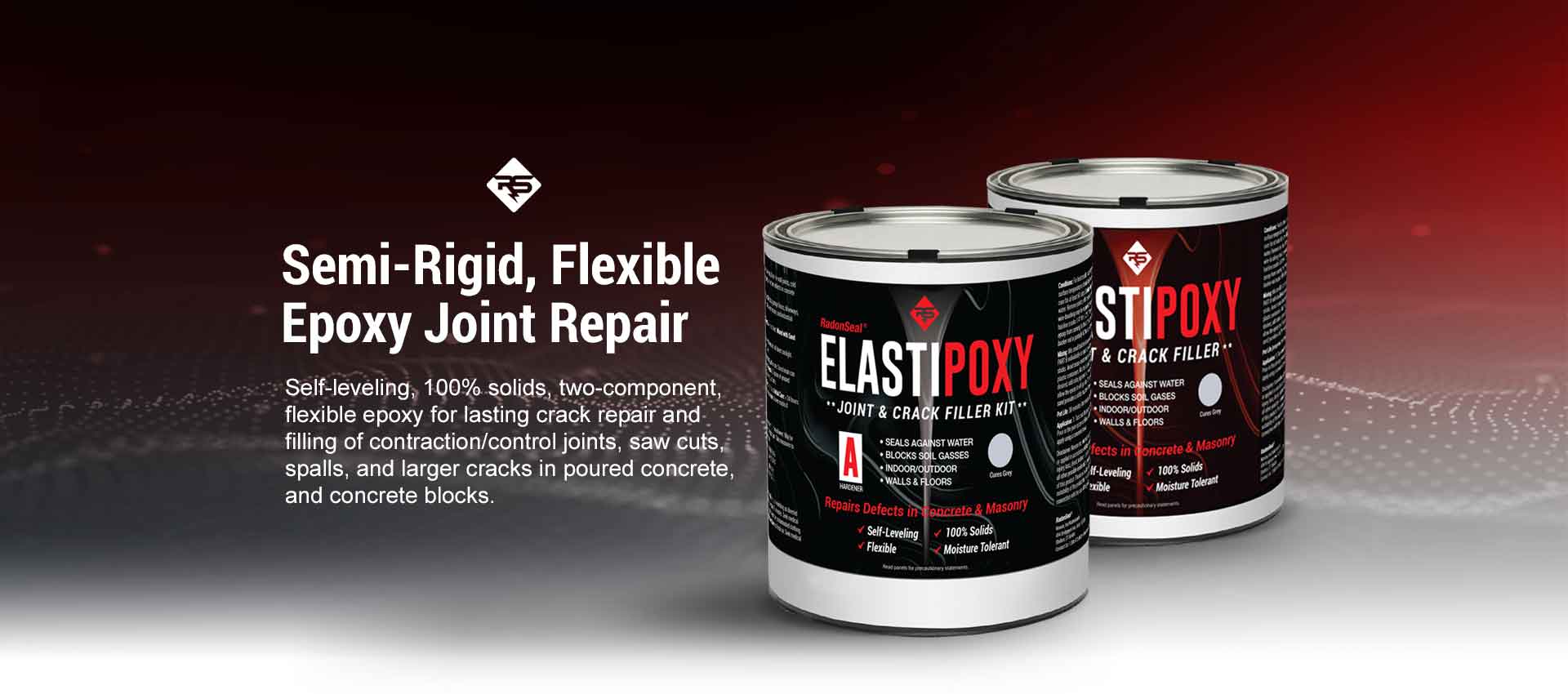
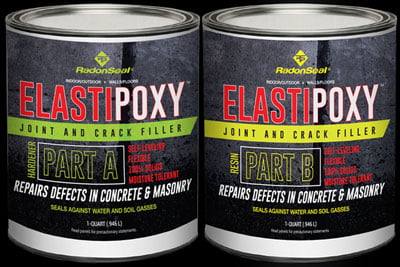
ElastiPoxy Control Joint & Crack Filler Kit
__________
Commercial & Residential Use. Indoor/Outdoor. ElastiPoxy® offers adequate elongation to allow for the natural expansion and contraction of concrete or masonry. Offers a tenacious bond to damp and dry surfaces. No noxious fumes or odors, making it environment and user-friendly.
Visual Application Guide
For detailed information on mixing ratio and application for your project, visit ElastiPoxy Joint Filler Application. If you have questions, please do not hesitate to contact a RadonSeal product expert.
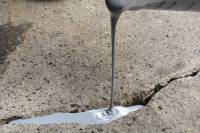
How To Use for Concrete Control Joints
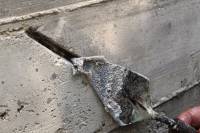
How To Use as a Rigid Repair for Cracks in Walls & Slabs
Coverage
Approximate coverage based on a routed out joint or crack 1/4″ wide by 1/2″ deep
Use Straight / Self Leveling – Using pure epoxy (no added sand), the 2-qt kit will fill approximately 75 linear feet. The 2-gal kit provides four times more volume at 300 linear ft.
Mixed With Sand – Using a standard 4:1 sand to epoxy ratio, the 2-qt kit will fill about 375 ft. of cracks.
ElastiPoxy Kit Contents
Each ElastiPoxy concrete crack filler kit comes complete and ready to use. If needed, purchase dry, silica construction sand (with no fines) from your nearby big-box store. You may also use a small plastic watering can or a cup with a spout for pouring the pure epoxy into joints and cracks in floors.
- 1 can of Base Resin (Compound A)
- 1 can of Epoxy Hardener (Compound B)
- 3 Measuring Cups
- 3 Drill Mixing Attachments
Repair Cracks in Concrete Driveways, Pool Decks, Factory Floors, Basements, and More
Appearance – Cures gray. Adding sand or sprinkling on sand before it cures makes the surface color and texture look more like concrete. ElastiPoxy is partially paintable. When using pure epoxy, it is best to roughen up the surface first with a grinder.
Since the pure ElastiPoxy is flexible and self-leveling, it is commonly used for sealing and repairing:
- WAREHOUSE, FACTORY CONCRETE FLOORS – Protect edges of contraction control joints against heavy wheel loads.
- SAW CUTS – Seals saw cuts in foundation slabs, basement floors, driveways, and garage floors.
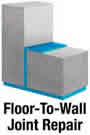
- BASEMENTS – Seal floor-to-wall joints in basements and buildings against water, vapor, and harmful radon gas.
- DRIVEWAYS, RUNWAYS, PARKING AREAS- Seal control joints against dirt, salts, water, freeze-thaw cycles. Repair minor defects.
- SIDEWALKS – Repair control joints and the troublesome sidewalk joint next to the building foundation.
- CONCRETE STAIRS – Fixes the joint between a foundation wall and adjacent stairs, which are subject to a lot of movement.
MIX ELASTIPOXY WITH SAND for a strong, permanent, and rigid repair of:
- CONCRETE SPALLING – Repair spalls, holes, and defects in concrete driveways,
patios, and pool decks. - CRACKS IN CONCRETE BLOCKS – Permanently seal cracks in concrete block or brick foundation walls.
- CRUMBLING CONCRETE – Use as a parging to repair and waterproof crumbling or honeycombed concrete.
- MORTAR JOINTS – Use for repairing porous, deteriorated, or crumbling mortar in concrete block foundations.
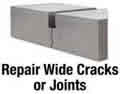
- STRESS CRACKS – Use for filling very wide cracks in concrete floors.
- RUSTING STEEL – Fill holes caused by rusting embedded steel in parking decks and bridges after coating the steel with pure ElastiPoxy.
- FORM TIES – Waterproof leaking from wire ties in poured concrete walls.
Cured ElastiPoxy Properties |
|||||
|---|---|---|---|---|---|
| Compressive Strength, min. | ASTM D 695 | 8,000 p.s.i. | Indentation Resistance | Mil-D-3134-E | no indent 0-2000 p.s.i. |
| Tensile Strength, min. | ASTM D 638 | 1,500 p.s.i. | Abrasion Resistance | ASTM D 1044 | < 45 mg loss |
| Tensile Elongation | ASTM D 638 | 25% | Bond Strength to Concrete | ACI 403 | > 350 p.s.i. |
| Flexural Modulus | ASTM D 790 | 95,000 p.s.i. | Bond Strength to Steel | ASTM D 570 | 1,950 p.s.i. |
| Hardness (Shore D) | ASTM D 2240 | 60 | Water Absorption | Mil-F-52505 | 10% |
| Impact Resistance | Mil-D-3134-E | passes 16 ft-lb | Fungus and Bacteria Resistance | Mil-F-52505 | no growth |
Customers’ feedback and tips on Repairing Cracks